Lipid nanoparticle (designed with an AI agent)
A lipid nanoparticle (LNP) of 80 nm, such as those that carry mRNA vaccines, in a coarse-grained model (SIRAH): an outer monolayer of lipids, a lipid phase inside it, and three water compartments bounded by monolayers, each with a piece of RNA, in water, in a truncated octahedron periodic cell with 860 Å between opposite hexagonal faces. The system has 5.6 million particles and 887 thousand molecules.
The system was designed by an AI agent (Claude Code) from an illustration of an LNP and a few sentences of description, in a conversation of a few steps. This page shows that conversation, and then the system, built as in the other tutorials. It is a proof of concept: the composition of the lipid phase and the RNA are placeholders, not a model of a real LNP.
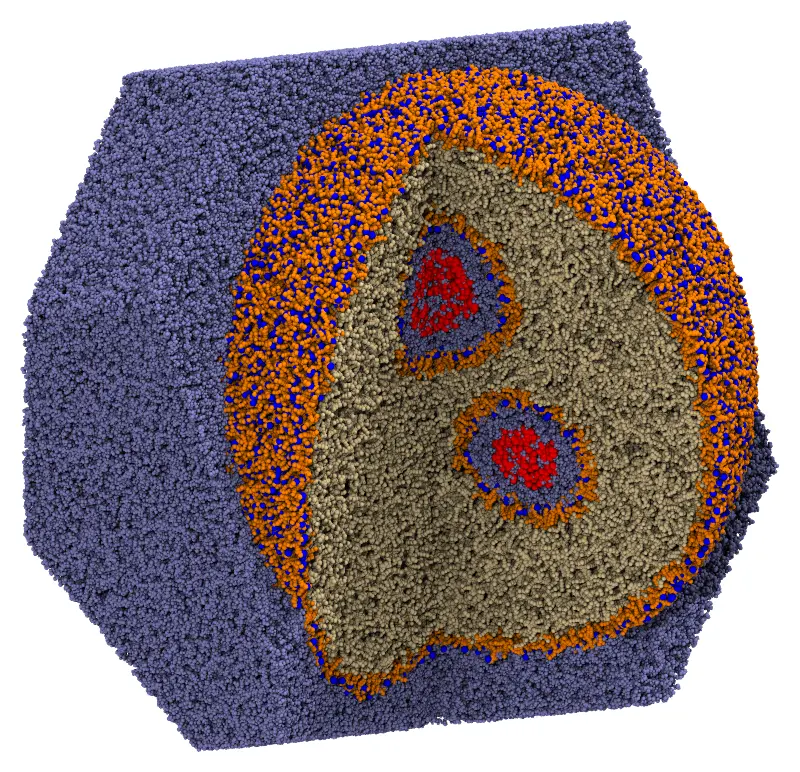
The nanoparticle with a quarter cut out: the heads (blue) and the chains (orange) of the lipids of the monolayers, the lipid phase (tan), and, in the compartments, water (light blue) and RNA (red). The water outside is shown behind the particle, up to the faces of the periodic cell.
The files are the packmol_lnp set of MolSimTestFiles: download and extract packmol_lnp.tar.gz (0.2 MB), which contains the two input files, monolayers.inp and lnp.inp, and the structures: popc.pdb, pope.pdb and pops.pdb (the lipids) and wt4.pdb (water), those of the Zika virion tutorial, and rna1.cif, rna2.cif and rna3.cif, the pieces of RNA.
From a sketch to a system
The starting point was an illustration of an LNP: a sphere with a lipid shell, and, inside it, smaller spheres bounded by lipids, with RNA and water. The request to the agent was (the prompts are quoted with small corrections):
What I want now is to try to build this system [the illustration]. The liposome
is about 80 nm wide, and inside there are three smaller ones. Inside each one
there's RNA and water; in the middle of the membranes there are lipids. I don't
know the composition. Outside there should be water, in an octahedron. The
system should be built coarse-grained. Can you evaluate that?

The exact details are not critical: this would be a proof of concept.
The agent read the illustration, proposed a geometry (the sizes and the positions of the compartments, the shells of the lipids), and estimated the numbers of molecules. The design was then corrected and simplified in a few exchanges:
The molecules. The structures of the molecules are for the user to provide: an agent can build rough models, but not ones fit for a simulation. Here, the lipids and the water of SIRAH of the Zika virion tutorial were used: POPC, POPE and POPS, 60:30:10, and the WT4 water. Before building anything, the agent confirmed with the user how the lipids are oriented by the constraints: the head bead (bead 1) and the end of a chain (bead 16, or 17 in POPS), from the structure files and the input of the Zika virion.
The layers. The layers of the illustration are monolayers, with the chains of the lipids pointing to the lipid phase between them: heads outwards in the outer layer, inwards (towards the water) in the compartments.
The geometry first. Only the four monolayers were packed first (
monolayers.inp, half a minute), to check the geometry: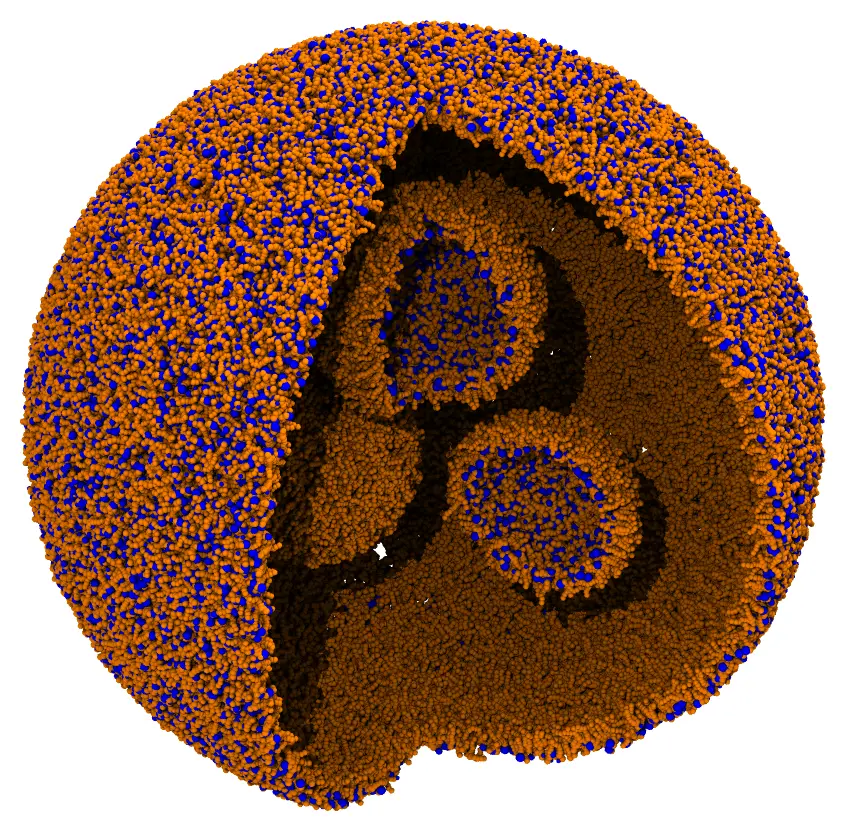
The four monolayers, with a quarter cut out.
The rest. Then:
Fill the inner part with POPC, the inner spheres with WT4 and a piece of mRNA
that fits in those spaces, and an octahedron of WT4 outside.
The agent wrote a script for the pieces of RNA: compact chains of 3 beads per nucleotide, of 1500, 1000 and 700 nucleotides, with the size that fits in each compartment (placeholders: a real structure of a coarse-grained mRNA would replace them), fixed at the centers of the compartments.
The scale of the radii. The lipids of the monolayers start the packing with their radii scaled by 5 (
radscale 5.0in their structure blocks; the default for molecules of up to 20 beads is 1), so that they spread over their surfaces before they settle (see Structure blocks). The POPC of the lipid phase was first given the same scale, and the first loop of the packing did not finish in 10 minutes, most likely because, inflated five-fold, it does not fit in its region, which is enclosed by the monolayers. The agent proposed a few alternatives; the one chosen was to start it at its radii. With that, the system packed in 5 minutes.
radscale scales the radii of the atoms at the start of the packing, decaying to their values in the first loops. Inflated molecules repel each other from farther, which spreads them over their regions: it is what lipids in a layer need, and Packmol uses it by default for molecules of more than 20 atoms (SIRAH lipids have 16 or 17 beads, so it is set here). But molecules that fill an enclosed region densely, as the lipid phase here, may not fit in it inflated, and the first loops make no progress: start those at their radii (radscale 1.0, the default for small molecules). When the first loop of a packing does not end, look at the radscale of the molecules of the crowded regions.
The illustration helped the agent understand what was wanted, but the decisions that mattered were made in the conversation: what to simplify, which models to use, what to check first. The input files below are those the agent wrote, with comments.
The system
The lipids of the monolayers are oriented by two beads: the head (bead 1) and the end of a chain (bead 16, or 17 in POPS). In the outer monolayer the head is beyond 395 Å from the center and the end of the chain within 388 Å; in a compartment, the head within the radius of the compartment, R, and the end of the chain beyond R + 8 Å:
| Component | Region (Å) |
|---|---|
| Outer monolayer | heads beyond 395, ends of the chains within 388 (from the center) |
| Compartment 1, center (0, 0, 150) | heads within 105, ends of the chains beyond 113; water within 102 |
| Compartment 2, center (−130, 0, −75) | heads within 95, ends of the chains beyond 103; water within 92 |
| Compartment 3, center (130, 0, −75) | heads within 85, ends of the chains beyond 93; water within 82 |
| Lipid phase (POPC) | within 388 of the center, beyond the ends of the chains of the compartments |
| Water outside | beyond 397 of the center, up to the faces of the periodic cell |
The numbers of molecules:
- Monolayers: 70 Ų per lipid, on the surface of the ends of the chains (outer monolayer) or of the heads (compartments): 27,027 lipids in the outer monolayer, and 1979, 1620 and 1297 in the compartments.
- Lipid phase: 85% of the volume left between the monolayers (inside the outer one, outside the compartments, minus the part of that volume taken by the chains of the monolayers), at 1250 ų per POPC: 138,077.
- Water: 330 ų per WT4 molecule (11 water molecules), in the compartments without the volume of the RNA (11,970, 8884 and 6299), and outside the nanoparticle (689,515).
The whole nanoparticle is packed at once, by lnp.inp: the pieces of RNA are fixed at the centers of the compartments, and everything else is packed around them. monolayers.inp packs the monolayers alone: it is how the geometry was checked while designing the system, and its output is not used by lnp.inp.
Fixing the pieces of RNA is not required here: free, each within the water sphere of its compartment, they pack too, but in 56 loops and 9 minutes, instead of 21 loops and 5 minutes, with thousands of molecules around them still active for some 30 loops. Large molecules inside a solvent are best fixed (or packed first, and then fixed, as the proteins of the Exosome); more complex ones, such as a real mRNA, all the more.
The geometry of the monolayers (optional)
The input file monolayers.inp (click to expand)
#
# The monolayers of a lipid nanoparticle of 80 nm (SIRAH coarse-grained lipids of the
# Zika example): the outer monolayer, heads outwards, and those of three compartments,
# heads inwards; the chains point to the lipid phase between them.
#
tolerance 2.0
radscale 5.0
output monolayers.cif

# To write only the initial placement of the molecules to the output file,
# without packing them (to check the constraints), uncomment the line below.
# check_initial_placement

# The outer monolayer: heads beyond 395.0, ends of the chains within 388.0
structure popc.pdb
  number 16216
  atoms 1
    outside sphere 0. 0. 0. 395.0
  end atoms
  atoms 16
    inside sphere 0. 0. 0. 388.0
  end atoms
end structure

structure pope.pdb
  number 8108
  atoms 1
    outside sphere 0. 0. 0. 395.0
  end atoms
  atoms 16
    inside sphere 0. 0. 0. 388.0
  end atoms
end structure

structure pops.pdb
  number 2703
  atoms 1
    outside sphere 0. 0. 0. 395.0
  end atoms
  atoms 17
    inside sphere 0. 0. 0. 388.0
  end atoms
end structure

# Compartment 1: center 0.0 0.0 150.0, heads within 105.0, ends of the chains beyond 113.0
structure popc.pdb
  number 1187
  atoms 1
    inside sphere 0.0 0.0 150.0 105.0
  end atoms
  atoms 16
    outside sphere 0.0 0.0 150.0 113.0
  end atoms
end structure

structure pope.pdb
  number 594
  atoms 1
    inside sphere 0.0 0.0 150.0 105.0
  end atoms
  atoms 16
    outside sphere 0.0 0.0 150.0 113.0
  end atoms
end structure

structure pops.pdb
  number 198
  atoms 1
    inside sphere 0.0 0.0 150.0 105.0
  end atoms
  atoms 17
    outside sphere 0.0 0.0 150.0 113.0
  end atoms
end structure

# Compartment 2: center -130.0 0.0 -75.0, heads within 95.0, ends of the chains beyond 103.0
structure popc.pdb
  number 972
  atoms 1
    inside sphere -130.0 0.0 -75.0 95.0
  end atoms
  atoms 16
    outside sphere -130.0 0.0 -75.0 103.0
  end atoms
end structure

structure pope.pdb
  number 486
  atoms 1
    inside sphere -130.0 0.0 -75.0 95.0
  end atoms
  atoms 16
    outside sphere -130.0 0.0 -75.0 103.0
  end atoms
end structure

structure pops.pdb
  number 162
  atoms 1
    inside sphere -130.0 0.0 -75.0 95.0
  end atoms
  atoms 17
    outside sphere -130.0 0.0 -75.0 103.0
  end atoms
end structure

# Compartment 3: center 130.0 0.0 -75.0, heads within 85.0, ends of the chains beyond 93.0
structure popc.pdb
  number 778
  atoms 1
    inside sphere 130.0 0.0 -75.0 85.0
  end atoms
  atoms 16
    outside sphere 130.0 0.0 -75.0 93.0
  end atoms
end structure

structure pope.pdb
  number 389
  atoms 1
    inside sphere 130.0 0.0 -75.0 85.0
  end atoms
  atoms 16
    outside sphere 130.0 0.0 -75.0 93.0
  end atoms
end structure

structure pops.pdb
  number 130
  atoms 1
    inside sphere 130.0 0.0 -75.0 85.0
  end atoms
  atoms 17
    outside sphere 130.0 0.0 -75.0 93.0
  end atoms
end structure
packmol monolayers.inpThis takes about 30 seconds with 14 threads, and writes the monolayers to monolayers.cif.
The nanoparticle
The input file lnp.inp (click to expand)
#
# A lipid nanoparticle of 80 nm (SIRAH coarse-grained lipids and water of the Zika
# example): an outer monolayer, heads outwards; three compartments bounded by monolayers,
# heads inwards, with WT4 water and a piece of RNA (fixed); POPC filling the lipid phase
# between them; WT4 water outside, in a truncated octahedron.
#
tolerance 2.0
output lnp.cif
pbc octahedral 0. 0. 0. 860.0
periodic_boundary_style octahedral

# To write only the initial placement of the molecules to the output file,
# without packing them (to check the constraints), uncomment the line below.
# check_initial_placement

# The lipids of the monolayers (16 or 17 beads) start with their radii scaled by 5,
# to spread over the surfaces; the water and the POPC of the lipid phase start at their
# radii (the default for molecules of up to 20 beads).

# The outer monolayer: heads beyond 395.0, ends of the chains within 388.0
structure popc.pdb
  number 16216
  atoms 1
    outside sphere 0. 0. 0. 395.0
  end atoms
  atoms 16
    inside sphere 0. 0. 0. 388.0
  end atoms
  radscale 5.0
end structure

structure pope.pdb
  number 8108
  atoms 1
    outside sphere 0. 0. 0. 395.0
  end atoms
  atoms 16
    inside sphere 0. 0. 0. 388.0
  end atoms
  radscale 5.0
end structure

structure pops.pdb
  number 2703
  atoms 1
    outside sphere 0. 0. 0. 395.0
  end atoms
  atoms 17
    inside sphere 0. 0. 0. 388.0
  end atoms
  radscale 5.0
end structure

# Compartment 1: center 0.0 0.0 150.0, heads within 105.0, ends of the chains beyond 113.0
structure popc.pdb
  number 1187
  atoms 1
    inside sphere 0.0 0.0 150.0 105.0
  end atoms
  atoms 16
    outside sphere 0.0 0.0 150.0 113.0
  end atoms
  radscale 5.0
end structure

structure pope.pdb
  number 594
  atoms 1
    inside sphere 0.0 0.0 150.0 105.0
  end atoms
  atoms 16
    outside sphere 0.0 0.0 150.0 113.0
  end atoms
  radscale 5.0
end structure

structure pops.pdb
  number 198
  atoms 1
    inside sphere 0.0 0.0 150.0 105.0
  end atoms
  atoms 17
    outside sphere 0.0 0.0 150.0 113.0
  end atoms
  radscale 5.0
end structure

# Compartment 2: center -130.0 0.0 -75.0, heads within 95.0, ends of the chains beyond 103.0
structure popc.pdb
  number 972
  atoms 1
    inside sphere -130.0 0.0 -75.0 95.0
  end atoms
  atoms 16
    outside sphere -130.0 0.0 -75.0 103.0
  end atoms
  radscale 5.0
end structure

structure pope.pdb
  number 486
  atoms 1
    inside sphere -130.0 0.0 -75.0 95.0
  end atoms
  atoms 16
    outside sphere -130.0 0.0 -75.0 103.0
  end atoms
  radscale 5.0
end structure

structure pops.pdb
  number 162
  atoms 1
    inside sphere -130.0 0.0 -75.0 95.0
  end atoms
  atoms 17
    outside sphere -130.0 0.0 -75.0 103.0
  end atoms
  radscale 5.0
end structure

# Compartment 3: center 130.0 0.0 -75.0, heads within 85.0, ends of the chains beyond 93.0
structure popc.pdb
  number 778
  atoms 1
    inside sphere 130.0 0.0 -75.0 85.0
  end atoms
  atoms 16
    outside sphere 130.0 0.0 -75.0 93.0
  end atoms
  radscale 5.0
end structure

structure pope.pdb
  number 389
  atoms 1
    inside sphere 130.0 0.0 -75.0 85.0
  end atoms
  atoms 16
    outside sphere 130.0 0.0 -75.0 93.0
  end atoms
  radscale 5.0
end structure

structure pops.pdb
  number 130
  atoms 1
    inside sphere 130.0 0.0 -75.0 85.0
  end atoms
  atoms 17
    outside sphere 130.0 0.0 -75.0 93.0
  end atoms
  radscale 5.0
end structure

# Compartment 1: the RNA (fixed at the center) and water
structure rna1.cif
  number 1
  center
  fixed 0.0 0.0 150.0 0. 0. 0.
end structure

structure wt4.pdb
  number 11970
  inside sphere 0.0 0.0 150.0 102.0
end structure

# Compartment 2: the RNA (fixed at the center) and water
structure rna2.cif
  number 1
  center
  fixed -130.0 0.0 -75.0 0. 0. 0.
end structure

structure wt4.pdb
  number 8884
  inside sphere -130.0 0.0 -75.0 92.0
end structure

# Compartment 3: the RNA (fixed at the center) and water
structure rna3.cif
  number 1
  center
  fixed 130.0 0.0 -75.0 0. 0. 0.
end structure

structure wt4.pdb
  number 6299
  inside sphere 130.0 0.0 -75.0 82.0
end structure

# The lipid phase: POPC without orientation, between the monolayers (with its radii
# scaled by 5 at the start, as those of the monolayers, the first loop of the packing
# did not finish in 10 minutes)
structure popc.pdb
  number 138077
  inside sphere 0. 0. 0. 388.0
  outside sphere 0.0 0.0 150.0 113.0
  outside sphere -130.0 0.0 -75.0 103.0
  outside sphere 130.0 0.0 -75.0 93.0
end structure

# Outside: water
structure wt4.pdb
  number 689515
  outside sphere 0. 0. 0. 397.0
end structure
First check the initial placement: uncomment the check_initial_placement line of the input file, and run it (see Checking the initial placement):
packmol lnp.inpThis takes 30 seconds with 14 threads, and 5 GB of memory:
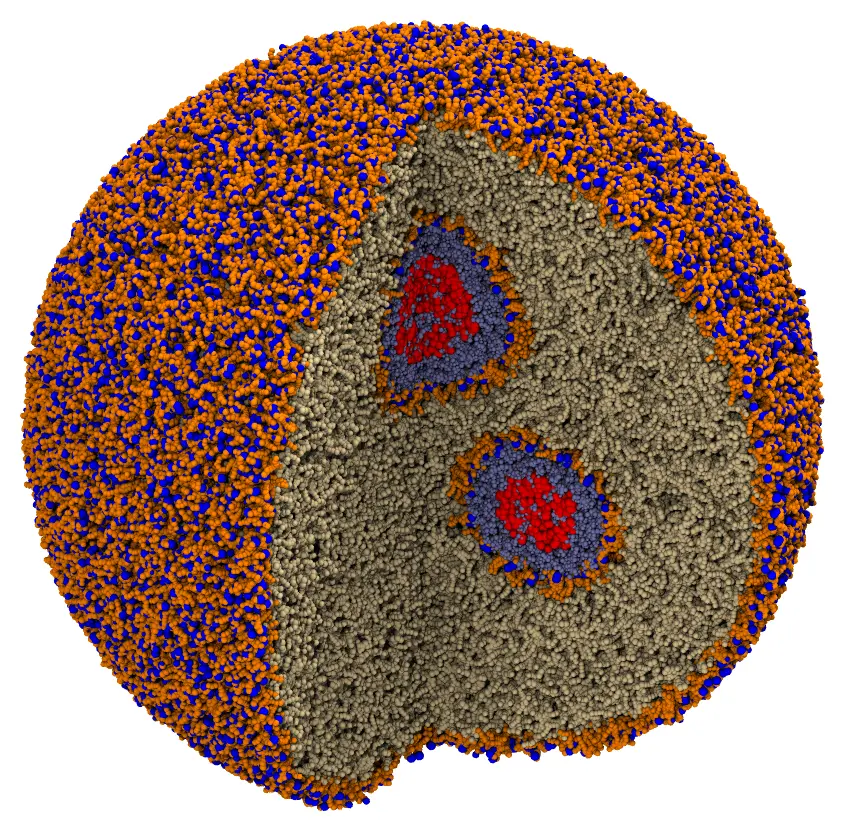
The initial approximation: the molecules are in their regions, but overlap.
Then comment the line again, and run the packing:
packmol lnp.inpThe packing converged in 21 loops, which took 5 minutes with 14 threads, using 10 GB of memory. The output, lnp.cif, has 1.5 GB.
The system has no ions, the lipid phase is POPC only, and the RNA pieces are not structures of a model of RNA. For a simulation, the composition of the lipid phase (ionizable lipids, cholesterol), the RNA and the ions would have to be chosen with care, and the system equilibrated (see Using your AI agent).
Julia script
The same system in Julia:
using Packmolorigin = [0., 0., 0.]# The lipids of a monolayer, POPC, POPE and POPS: the head (bead 1) and# the end of a chain (bead 16, or 17 in POPS), with their radii scaled# by 5 at the startfunction monolayer(numbers, head_region, tail_region) files = ("popc.pdb", "pope.pdb", "pops.pdb") tails = (16, 16, 17) [structure_type(file; number, radscale = 5.0, atom_constraints = [[1] => head_region, [tail] => tail_region]) for (file, number, tail) in zip(files, numbers, tails)]endcompartments = [ (center = [0., 0., 150.], R = 105., lipids = (1187, 594, 198), rna = "rna1.cif", water = 11970), (center = [-130., 0., -75.], R = 95., lipids = (972, 486, 162), rna = "rna2.cif", water = 8884), (center = [130., 0., -75.], R = 85., lipids = (778, 389, 130), rna = "rna3.cif", water = 6299),]outer = monolayer((16216, 8108, 2703), OutsideSphere(origin, 395.), InsideSphere(origin, 388.))inner = [monolayer(c.lipids, InsideSphere(c.center, c.R), OutsideSphere(c.center, c.R + 8)) for c in compartments]# The RNA, fixed at the center of each compartment, and the water around itcontents = [ [structure_type(c.rna; number = 1, center = :geometric, fixed = (c.center, [0., 0., 0.])), structure_type("wt4.pdb"; number = c.water, constraints = [InsideSphere(c.center, c.R - 3)])] for c in compartments]# The lipid phase, at its radii from the startfilling = structure_type("popc.pdb"; number = 138077, constraints = [InsideSphere(origin, 388.); [OutsideSphere(c.center, c.R + 8) for c in compartments]])water = structure_type("wt4.pdb"; number = 689515, constraints = [OutsideSphere(origin, 397.)])molecules = [outer; reduce(vcat, inner); reduce(vcat, contents) filling; water]system = PackmolSystem(molecules; output = "lnp.cif", tolerance = 2.0, unitcell = octahedral_unitcell(Float64, 860.0), # centered at the origin # check_initial_placement = true, # uncomment to only place the molecules)# Write the output in the shape of the truncated octahedrontriclinic_to_octahedral(system)packmol(system)