ParticleSystem interface
The mapped function
The purpose of CellListMap is to compute a pairwise-dependent function for all pairs of particles that are closer to each other than a defined cutoff. This pairwise function must be implemented by the user and adhere to the following interface:
function f(pair, output)
    (; i, j, x, y, d2, d) = pair
    # update output variable using above pair data
    return output
end
where pair is a NeighborPair object, containing fields i, j, x, y, d2 and d, which here we extract from the object using destructuring syntax.
x and y are the positions of the particles, already wrapped relative to each other according to the periodic boundary conditions (a minimum-image set of positions), i and j are the indexes of the particles in the arrays of coordinates, d2 is the squared distance between the particles, d is the distance, and output is the variable to be computed.
Details of the mapped function interface
The pair input of the function contains the data that the user may use to update the output variable. The NeighborPair object contains fields x, y, i, j, d2 and the lazily computed d, meaning:
| Input/Output | Type | Meaning |
|---|---|---|
x | SVector | The coordinates of particle i of the pair. |
y | SVector | The coordinates of particle j of the pair (minimum-image relative to x). |
i | Int | Index of first particle in the original array of coordinates. |
j | Int | Index of second particle in the original array of coordinates. |
d2 | <:Real | Squared distance between the particles. |
d | <:Real | Squared distance between the particles (computed lazily). |
output | user defined | the name of the variable to be updated. |
Notes: x and y may be 2D or 3D vectors, depending on the dimension of the system. The type of the coordinates of x, y, and of d2 are dependent on the input arrays and cutoff, and can be Float64, Float32, unitful quantities, etc.
| Return value | Type | Meaning |
|---|---|---|
output | user defined | the updated value of output. |
The output variable must be returned by the function, being it mutable or immutable.
The figure below illustrates the meaning of the coordinates in a NeighborPair object.
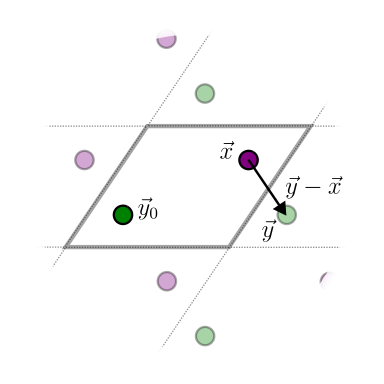
Here $\vec{x}$ and $\vec{y}_0$ are the coordinates as provided by the user, which in this case fall inside the reference unitcell. But the image $\vec{y}$ of $\vec{y}_0$ is closer to $\vec{x}$. The NeighborPair object will contain the coordinates pair.x ==$\vec{x}$ and pair.y ==$\vec{y}$, such that pair.y - pair.x will be tipicaly the vector used, for example, to compute the force between the particles. Also, pair.d == norm(pair.y - pair.y) and corresponds to the norm of $\vec{y} - \vec{x}$, as represented in the figure.
Basic examples
For example, computing the energy, as the sum of the inverse of the distance between particles, can be done with a function like:
using CellListMap
function energy(pair, u)
    u += 1 / pair.d
    return u
end
energy (generic function with 1 method)The coordinates and other properties of the system are defined with the ParticleSystem constructor, for example:
system = ParticleSystem(
    positions=rand(3,10^4),
    unitcell=[1,1,1],
    cutoff=0.1,
    output=0.0,
    output_name=:energy,
)
ParticleSystem1{energy} of dimension 3, composed of:
10000 particles - cell lists are up to date.
Box{CellListMap.OrthorhombicCell, 3}
unit cell matrix = [ 1.0 0.0 0.0; 0.0 1.0 0.0; 0.0 0.0 1.0 ]
cutoff = 0.1
number of computing cells on each dimension = [13, 13, 13]
computing cell sizes = [0.1, 0.1, 0.1] (lcell: 1)
Total number of cells = 2197
CellListMap.CellList{3, Float64}
10000 real particles.
1000 cells with real particles.
17310 particles in computing box, including images.
Parallelization auxiliary data set for 10 batch(es).
Type of output variable (energy): Float64The output=0.0 defines the variable type, which can be simple scalars or any compound object.
Finally, the pairwise! function applies the function energy to all pairs of particles whose distances are within the cutoff:
u = pairwise!(energy, system)3.132764503839809e6Note that the energy function only uses pair.d (the distance), but all other fields (pair.x, pair.y, pair.i, pair.j, pair.d2) are available.
The mapped function might require additional parameters, such as the masses of the particles. In this case, we can use a closure to provide such data:
function gravitational_energy(pair, u, masses)
    (; i, j, d)  = pair
    u += masses[i]*masses[j] / d
    return u
end
const masses = rand(10^4) # some random masses
u = pairwise!((pair, u) -> gravitational_energy(pair, u, masses), system)788194.8136063004Here we reinforce the fact that the functions defined above compute the contribution to the energy of the interaction of a single pair of particles. This function will be called for every pair of particles within the cutoff, automatically, in the pairwise! call.
The output of the CellListMap computation may be of any kind. Most commonly, it is an energy, a set of forces, or other data type that can be represented either as a number, an array of numbers, or an array of vectors (SVectors in particular), such as an arrays of forces.
Additionally, the properties are frequently additive (the energy is the sum of the energy of the particles, or the forces are added by summation).
For these types of output data the usage does not require the implementation of any data-type dependent function.
The ParticleSystem constructor
The ParticleSystem constructor receives the properties of the system and sets up automatically all the data structures needed for the pairwise! computation.
Input parameters
| Keyword | Type | Default | Description |
|---|---|---|---|
positions / xpositions | AbstractVector or AbstractMatrix | — (required) | Coordinates of the (first) set of particles. positions is an alias for xpositions for single-set computations. Accepts a Vector{SVector}, a vector of plain vectors, or a (D, N) matrix. |
ypositions | AbstractVector, AbstractMatrix, or Nothing | nothing | Coordinates of the second set of particles. If provided, the pairwise! function will iterate over all cross-pairs between the two sets. |
cutoff | Number | — (required) | Cutoff distance. Only pairs within this distance contribute to the output. |
unitcell | vector, matrix, or Nothing | nothing | Unit cell for periodic boundary conditions. A vector of sides defines an orthorhombic cell (faster); a matrix defines a triclinic cell (columns are lattice vectors). nothing means non-periodic. |
output | any | — (required) | Initial value of the output variable. Determines the type of the result; typically 0.0 for a scalar, or a pre-allocated array for forces. |
output_name | Symbol | :output | Name used to access the output from the system: system.energy if output_name=:energy. |
parallel | Bool | true | Enable multi-threading. |
nbatches | Tuple{Int,Int} | (0,0) | Number of batches for parallelization (see Fine control of the parallelization). |
- Systems can be 2 or 3-dimensional.
Unitfulquantities are supported when appropriate unit types are provided for all input parameters.
After construction, use update! to change coordinates, cutoff, unit cell, or parallelization between pairwise! calls. See the Updating the system section for details.
Properties
The following properties can be read from a ParticleSystem object using dot notation:
| Property | Read | Write | Description |
|---|---|---|---|
xpositions | ✓ | — | Coordinates of the first (or only) set of particles, as an array-like object. Individual elements can be set by indexing (sys.xpositions[i] = ...). |
positions | ✓ | — | Alias for xpositions. |
ypositions | ✓ | — | Coordinates of the second set of particles (two-set systems only). |
cutoff | ✓ | ✓ | Current cutoff distance. Assignment updates the internal box. |
unitcell | ✓ | ✓ | Current unit cell as a matrix. Assignment updates the internal box. |
parallel | ✓ | ✓ | Whether multi-threading is enabled. |
output | ✓ | ✓ | The output variable of the computation. |
OutputName | ✓ | — | Read-only alias for output using the name given in output_name. For example, sys.energy if output_name=:energy. |
For example, using the system defined in the example above:
system.energy # access output by its name788194.8136063004system.cutoff # read current cutoff0.1system.unitcell # read current unit cell3×3 StaticArraysCore.SMatrix{3, 3, Float64, 9} with indices SOneTo(3)×SOneTo(3):
1.0 0.0 0.0
0.0 1.0 0.0
0.0 0.0 1.0Writable properties can be assigned directly:
system.cutoff = 0.2
system.unitcell = [2, 2, 2]
system.parallel = false
system
ParticleSystem1{energy} of dimension 3, composed of:
10000 particles - positions changed - cell lists are outdated.
Box{CellListMap.OrthorhombicCell, 3}
unit cell matrix = [ 2.0 0.0 0.0; 0.0 2.0 0.0; 0.0 0.0 2.0 ]
cutoff = 0.2
number of computing cells on each dimension = [13, 13, 13]
computing cell sizes = [0.2, 0.2, 0.2] (lcell: 1)
Total number of cells = 2197
CellListMap.CellList{3, Float64}
10000 real particles.
1000 cells with real particles.
17310 particles in computing box, including images.
Parallelization auxiliary data set for 10 batch(es).
Type of output variable (energy): Float64