Lignin particle in acetone and water
A particle of lignin in a mixture of acetone and water, with all atoms: 70 oligomers of spruce lignin packed in a dense sphere, and the solvent around it. The oligomers are flexible, turning about all their rotatable bonds, which are found from their bonds (rotatable all, see Rotatable bonds), and the particle is too dense to pack from a random placement: it is packed at half its density, and compressed (Packing by compression). The solvent is then packed around the particle, fixed. The same molecules are also packed dispersed in the solvent.
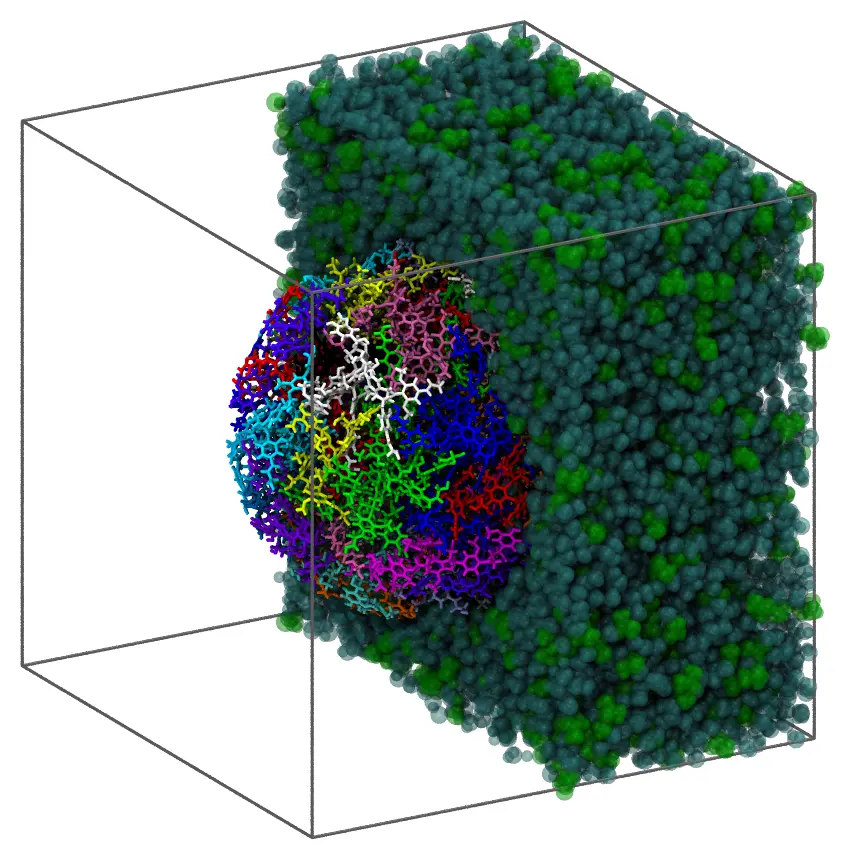
The lignin particle, each oligomer in a color, and the acetone (green) and the water (cyan) of the half of the cell beyond a cut through the middle of the particle.
Files: the oligomers, lignin_L3.pdb, lignin_L5.pdb, lignin_L22.pdb, lignin_L28.pdb, lignin_L40.pdb, lignin_L41.pdb, lignin_L63.pdb, lignin_L67.pdb, lignin_L86.pdb and lignin_L90.pdb; acetone.pdb, water.pdb, and the input files particle.inp, solvation.inp and dispersed.inp.
The structures
- The lignin: oligomers of spruce lignin (a softwood lignin, mostly of guaiacyl units), built by LigninBuilder (Vermaas et al., ACS Sustainable Chem. Eng. 7, 3443, 2019) from its library of spruce lignin: 100 oligomers, with the linkages of natural lignin (β-O-4, β-5, β-β, 5-5, ...), from 85 to 5949 atoms. Ten of the 68 oligomers of 120 to 400 atoms (one in seven, by size) are used here: 6 to 16 units, 141 to 375 atoms, 1069 to 2841 g/mol. Each comes with its bonds (
CONECTrecords). - The solvent: acetone and water (TIP3P), all atoms.
Building the molecules is not the job of Packmol. The oligomers were built and minimized with LigninBuilder and NAMD (its protocol), by build_lignin.tcl (a VMD script), and written with their bonds. The structures of LigninBuilder have clashes and stretched bonds before the minimization: the bonds that close the rings of some linkages are part of rigid fragments, and Packmol keeps their geometry as it is.
The rotatable bonds
The oligomers are branched, with rings in their linkages, and a different molecule each: the rotatable bonds are found by rotatable all, from the bonds of the CONECT records of the files. These are the bonds not in rings between heavy atoms with other heavy atoms bonded to them, and single for sure (see Rotatable bonds): the bonds of the linkages (Cα–Cβ, Cβ–O4, O4–C4, ...), the bonds of the side chains and of the methoxy groups to the rings, and the 5-5 bonds between rings. The ring–Cα bonds of the coniferyl alcohol end groups (Cα=Cβ) do not turn, as the double bonds themselves. Each oligomer has 24 to 72 rotatable bonds, which cut it into rigid fragments of 1 to 11 heavy atoms (with their hydrogens):
structure lignin_L5.pdb
  number 7
  rotatable all
  inside sphere 0. 0. 0. 33.
end structure
When packing, the number of bonds found is printed for each oligomer:
Rotatable bonds of lignin_L5.pdb: 28 foundWhether a bond is single is deduced from the numbers of bonds of its atoms, which requires the structure with all its hydrogen atoms (as here).
The numbers of molecules
- The particle: 7 copies of each of the 10 oligomers, 70 molecules of 116,600 g/mol together, 15,463 atoms, in a sphere of 33 Å: 1.30 g/cm³, the density of solid lignin.
- The solvent: acetone and water, 30:70 by volume, in a periodic cube of 100 Å. The volume left by the particle, 849,500 ų, holds 2073 molecules of acetone (0.785 g/mL) and 19,877 of water (1.0 g/mL), at their densities as pure liquids (the excess volume of the mixture is neglected).
The system has 95,824 atoms.
The lignin particle
The input file particle.inp (click to expand)
#
# A particle of lignin: 70 oligomers of spruce lignin (7 copies of 10 of them, built with
# LigninBuilder), in a sphere of 33 Å, at 1.30 g/cm³ (the density of lignin). The
# oligomers are flexible (every rotatable bond found from their bonds turns, `rotatable
# all`), and the particle is too dense to pack from a random placement: it is packed at
# half the density, and compressed (`use_compression`).
#
tolerance 2.0
output particle.pdb
use_compression 0.5

# To write only the initial placement of the molecules to the output file,
# without packing them (to check the constraints), uncomment the line below.
# check_initial_placement

structure lignin_L3.pdb
  number 7
  rotatable all
  inside sphere 0. 0. 0. 33.
end structure

structure lignin_L5.pdb
  number 7
  rotatable all
  inside sphere 0. 0. 0. 33.
end structure

structure lignin_L22.pdb
  number 7
  rotatable all
  inside sphere 0. 0. 0. 33.
end structure

structure lignin_L28.pdb
  number 7
  rotatable all
  inside sphere 0. 0. 0. 33.
end structure

structure lignin_L40.pdb
  number 7
  rotatable all
  inside sphere 0. 0. 0. 33.
end structure

structure lignin_L41.pdb
  number 7
  rotatable all
  inside sphere 0. 0. 0. 33.
end structure

structure lignin_L63.pdb
  number 7
  rotatable all
  inside sphere 0. 0. 0. 33.
end structure

structure lignin_L67.pdb
  number 7
  rotatable all
  inside sphere 0. 0. 0. 33.
end structure

structure lignin_L86.pdb
  number 7
  rotatable all
  inside sphere 0. 0. 0. 33.
end structure

structure lignin_L90.pdb
  number 7
  rotatable all
  inside sphere 0. 0. 0. 33.
end structure
The particle is too dense to pack from a random placement. With use_compression 0.5, it is first packed at half its density, in a sphere of 41.6 Å (33 × 2^(1/3)), as rigid molecules and then flexible, and then compressed to the sphere of 33 Å, in steps. At this density, some steps do not converge: the packing is then relaxed at a lower density and compressed again from there (see Packing by compression).
Check the initial placement first
Uncomment the check_initial_placement line of the input file, and run it (see Checking the initial placement): the initial placement is that of the expanded sphere, with the oligomers as rigid molecules:
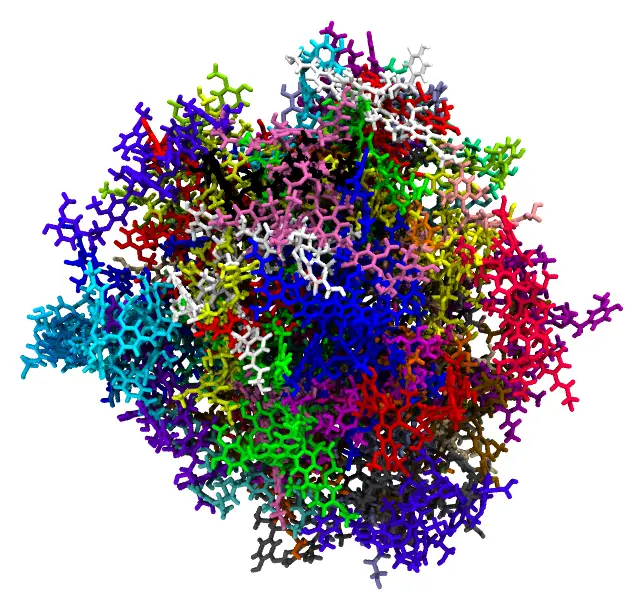
The initial placement of the oligomers, in the expanded sphere.
When it looks like this, comment the line again, and run the packing.
Packing
packmol particle.inpThe packing at half the density, and then the compression, in 15 to 60 steps, take about one minute with 14 threads:
  Compression step    1: density   58.32% of the target, converged (0.3 s)
  ...
  Compressed to the density of the input in 36 steps (67.3 s).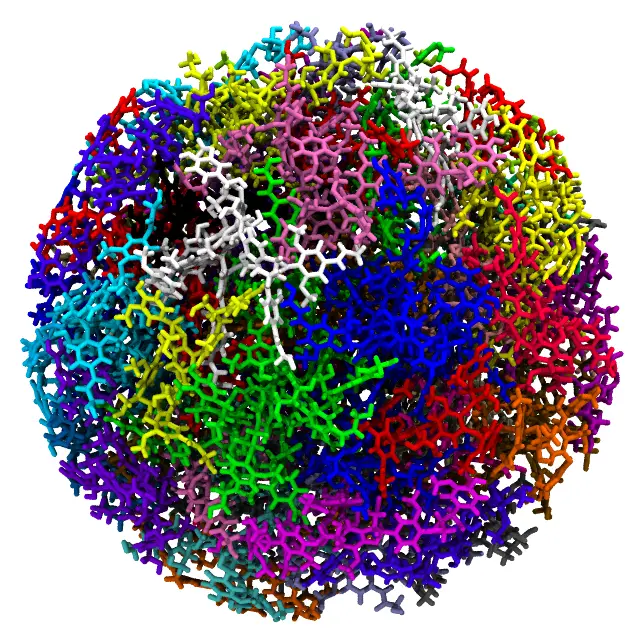
The lignin particle: 70 oligomers, each in a color.
The bonds are kept to 0.09 Å.
The solvent
The input file solvation.inp (click to expand)
#
# The lignin particle (the output of particle.inp), fixed at the center of a periodic
# cube of 100 Å, in a mixture of acetone and water (30:70 by volume).
#
tolerance 2.0
output lignin.pdb
pbc -50. -50. -50. 50. 50. 50.

# To write only the initial placement of the molecules to the output file,
# without packing them (to check the constraints), uncomment the line below.
# check_initial_placement

# The particle, fixed where it was packed
structure particle.pdb
  number 1
  fixed 0. 0. 0. 0. 0. 0.
end structure

# The solvent fills the rest of the cell
structure water.pdb
  number 19877
end structure

structure acetone.pdb
  number 2073
end structure
The particle, particle.pdb, is a single structure, fixed where it was packed (with fixed 0. 0. 0. 0. 0. 0., its coordinates are kept as they are), at the center of the periodic cube. The acetone and the water fill the cell around it, with no constraints:
packmol solvation.inpIt takes a few seconds.
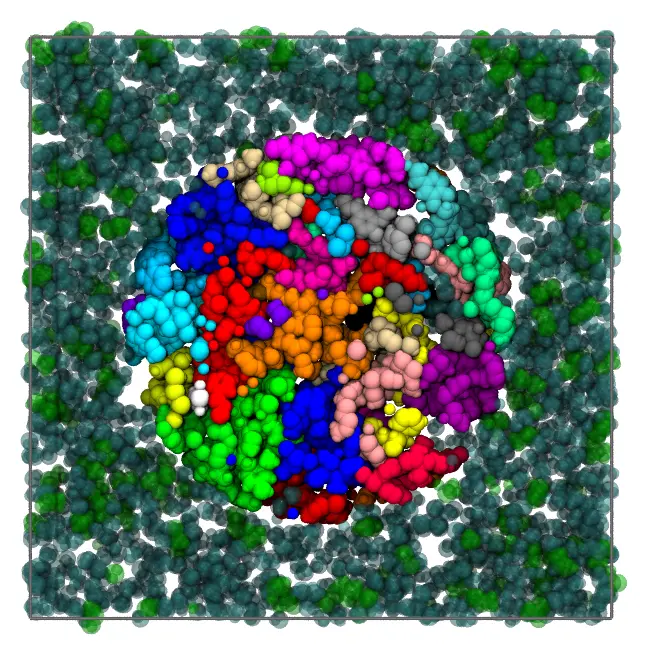
A slab of 10 Å through the middle of the cell: the atoms of the oligomers (each in a color), of the acetone (green) and of the water (cyan).
The dispersed lignin
The same molecules can be packed dispersed in the solvent: the 70 oligomers, flexible, and the acetone and the water, all in the periodic cube, with no constraints. At this concentration (194 mg/mL of lignin), they pack directly, with no compression:
The input file dispersed.inp (click to expand)
#
# The lignin dispersed in the mixture of acetone and water (30:70 by volume): the 70
# oligomers of the particle (particle.inp), flexible, and the solvent of solvation.inp,
# all mixed in the periodic cube of 100 Å.
#
tolerance 2.0
output dispersed.pdb
pbc -50. -50. -50. 50. 50. 50.

# To write only the initial placement of the molecules to the output file,
# without packing them (to check the constraints), uncomment the line below.
# check_initial_placement

structure lignin_L3.pdb
  number 7
  rotatable all
end structure

structure lignin_L5.pdb
  number 7
  rotatable all
end structure

structure lignin_L22.pdb
  number 7
  rotatable all
end structure

structure lignin_L28.pdb
  number 7
  rotatable all
end structure

structure lignin_L40.pdb
  number 7
  rotatable all
end structure

structure lignin_L41.pdb
  number 7
  rotatable all
end structure

structure lignin_L63.pdb
  number 7
  rotatable all
end structure

structure lignin_L67.pdb
  number 7
  rotatable all
end structure

structure lignin_L86.pdb
  number 7
  rotatable all
end structure

structure lignin_L90.pdb
  number 7
  rotatable all
end structure

structure water.pdb
  number 19877
end structure

structure acetone.pdb
  number 2073
end structure
packmol dispersed.inpIn this single run, the oligomers are first packed as rigid molecules, with the solvent, and then released and packed flexible. It takes from a few seconds to about a minute (when the packing of the rigid oligomers does not converge, it runs for its 500 loops before they are released).
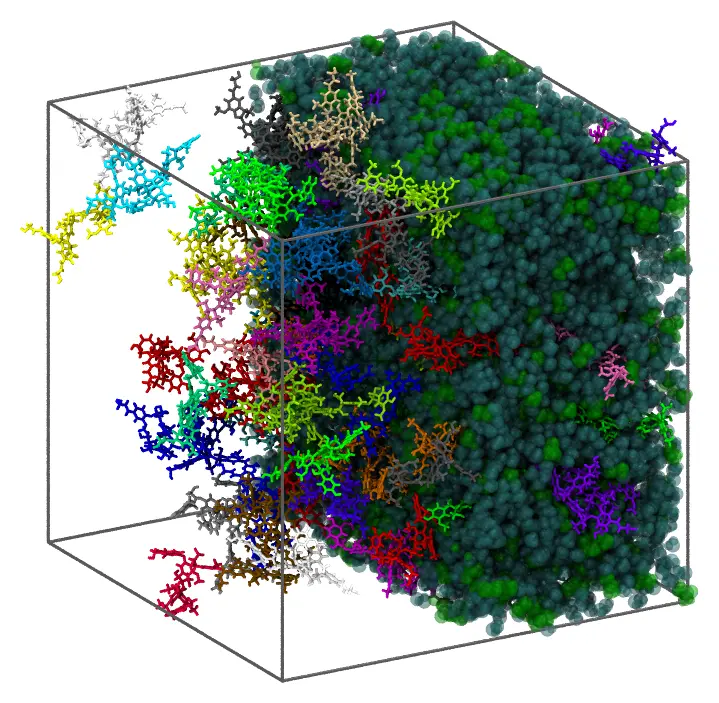
The oligomers dispersed in the solvent, of which the half of the cell beyond a cut through the middle is shown. The oligomers are whole, placed in the cell by their centers: some cross its faces.
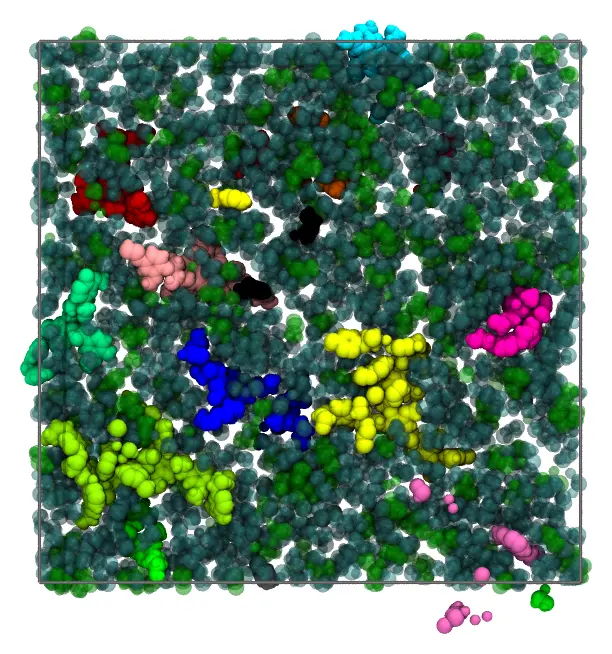
A slab of 10 Å through the middle of the cell.
Julia script
using Packmolorigin = [0., 0., 0.]# The particle: 7 copies of each oligomer, all their rotatable bonds turningnames = ["L3", "L5", "L22", "L28", "L40", "L41", "L63", "L67", "L86", "L90"]oligomers = [ flexible_structure("lignin_$name.pdb"; number = 7, rotatable = :all, constraints = [InsideSphere(origin, 33.)], ) for name in names]particle = PackmolSystem(oligomers; output = "particle.pdb", tolerance = 2.0, use_compression = 0.5, # check_initial_placement = true,)packmol(particle)# The solvent, around the particle, fixedlignin = structure_type("particle.pdb"; number = 1, fixed = (origin, origin),)water = structure_type("water.pdb"; number = 19877)acetone = structure_type("acetone.pdb"; number = 2073)system = PackmolSystem([lignin, water, acetone]; output = "lignin.pdb", tolerance = 2.0, unitcell = [100. 0. 0.; 0. 100. 0.; 0. 0. 100.], # centered at the origin)packmol(system)# The lignin dispersed in the solventdispersed_oligomers = [ flexible_structure("lignin_$name.pdb"; number = 7, rotatable = :all, ) for name in names]dispersed = PackmolSystem([dispersed_oligomers; water; acetone]; output = "dispersed.pdb", tolerance = 2.0, unitcell = [100. 0. 0.; 0. 100. 0.; 0. 0. 100.], # centered at the origin)packmol(dispersed)